This section of cornice from the original door hood, which I talked about in my last post, has turned out to contain a wealth of information about the past, that has guided our plans for the recreation and decoration of the new door case.
Firstly, we asked paint analyst Cathy Britain to take a sample of the thick coating of paint on it. There turned out to be 42 schemes (equating to more than 80 layers of paint, counting the undercoats) since 1725. Meaning an average of 5 years between each redecoration until the mid 20th century.
The first scheme was a pale stone colour, that we’ve matched to a Brouns linseed oil paint, and plan to use as the base colour of our new scheme – for the windows and door case.
We discovered a very interesting technique 10 schemes in (approx mid to late 18th century) where a stone colour had a texture layer of sand added to enhance the illusion of stone. Watch the video to see more. Sanding was used extensively in the 18th and 19th centuries (and was used for the exterior of Kenwood House in Hampstead around the same time as this layer), but is rarely seen today.
We’re going to experiment with using sanding for the new door case, which should give the illusion of the pillars and cornices etc being made of stone rather than timber.
Unfortunately we don’t know what colour the front door will have been, as we have no remains of the original door – in the early 18th century, all external joinery except the front door is likely to have been painted a single colour. However, in the 19th and start of 20th centuries, there were many grained layers found on the cornice – a technique where timber, usually pine, is painted to resemble oak or marble. And we have the 1909 photo showing the original external shutters with oak graining and the door case with marble graining.
So we’ve decided to use oak graining for our new external shutters and front door, which completes our scheme for the exterior joinery.
For more a more detailed look at the paint analysis process, watch the video below
This unassuming piece of wood is the last surviving fragment of the original ornate door canopy and corbels from 2 Wilkes Street’s door surround.
Dan Cruickshank has been a guardian of these streets since the 1970s when he helped save these houses from demolition, and he’s kept this fragment safe for nearly 50 years!
“I’ve kept an eye on number 2 since the early 1970s, documenting its changing fortunes. I was particularly gripped by its fine door hood – a thing of beauty but neglected and, in parts, far advanced in decay. It was the last of the William Tayler bracketed door hoods – all embellished with cherub’s heads – to survive. There had been two on houses in Fournier Street (the existing hooded door surrounds are relatively recent copies based on my photographs of the Wilkes Street example). But the Wilkes Street example was not destined to survive. One day – in about 1974 – I went to look at the door hood and it had gone – swept away by a market lorry I suppose. I found one fragment of a carved portion of its cornice lying on the pavement. That was all.”
Dan has now entrusted me with the ongoing preservation of it. My plan is to recreate the rest of the hood and put this original piece back in place.
There’s a very thick coating of paint, that within will hold clues as to the history of the external decoration, perhaps back to the original colour scheme from 1725. And underneath the paint, if we chip off a small section, we will have a clearer view of the original design and carving technique to inform the new carver’s recreation.
Hand-blown glass was the norm before 1900, giving windows a characterful, wobbly appearance, and blemishes (“reams” – which are small waves or folds in the glass – and “seeds” – small air bubbles).
Cylinder (or “muff”) glass was common in the 17th and early 18th centuries. It was made by blowing a cylinder of glass and splitting it lengthwise, and then, as the glass cooled, unrolling it to create a flat plate. Although cheaper, this process was mostly abandoned by the mid 1700s in favour of the superior Crown Glass. This new process involved blowing the glass into a bubble at the end of a long tube, then cutting the end of the bubble off and spinning it into a disc shape up to 5 or 6 feet across. As the glass didn’t come into contact with any other materials or surfaces in its production, it had a particularly fine lustre and, with the varying thickness and concentric circles formed by the spinning of the glass, gave windows a distinctive reflective quality. The glass was thicker and more opaque towards the central “bullseye”, which would either be discarded or used for basement, attic or rear windows.
Unfortunately, Crown Glass is hard to find these days, but some companies still produce cylinder glass. I’ve bought some to put in these 3 new sash windows. It’s very expensive compared to regular modern glass, so I’ve not used it in every pane – and it’s more common to see plain glass mixed in with hand blown, as panes get replaced over the centuries.
The photo below is from a house around the corner and shows the amazing ripple effect and the mix of old and modern glass.
Here’s a video of Mark the glazer installing the glass into the 3 new sash windows
Some of the extremes of the window tax effect can be seen in these wonderful photos by photographer Andy Billman (you can buy prints of these from his “Daylight Robbery” collection – I couldn’t resist getting one of the first photo!)
Although it’s hard to know for certain which were the result of window tax or other reasons, it’s likely many of these windows were bricked-in to reduce their tax bill – see my previous post about Window Tax.
Legend has it that in 1850 when the first motion was put before parliament to repeal this unpopular tax, MPs cried “daylight robbery!” when the matter was debated, which is supposedly where the saying originated.
The tax wasn’t as unpopular as its predecessor though: “hearth tax”, where wealth was measured by the number of fireplaces in a house. For all the ill effects of blocking in windows, it’s perhaps not so bad as demolishing chimneys – especially at this time of year! And one upside of blocking in windows, which people soon realised, is that blocking superfluous windows in the rear of the house next to hearths could cut down on heat-loss!
Though strangely the hearth tax was particularly unpopular due to it being an invasion of privacy – exposing your home to be entered and searched by a total stranger. Similarly to how income tax was unthinkable at the time, because these private matters weren’t considered the business of government!
Bricked up “blind” windows are often the result of the very unpopular “window tax”, imposed from 1696 to 1851. Although income tax had been proposed from time to time, it was considered an unacceptable governmental intrusion into private matters, and a potential threat to personal liberty. So number of windows (and therefore size of house) was deemed a good proxy for wealth. The more windows you had, the more tax you’d pay.
It was introduced in 1696, with a flat rate per house of 2 shillings, with an extra 4 shillings for houses with between 10 and 20 windows, or extra 8 shillings for those above 20. But it was perhaps the progressive tax that began in 1747 that will have triggered the most bricking up of windows to avoid tax. For houses between 10 and 14 windows, you’d pay 6d for EVERY window (“d” is pence in old money). And for houses between 15 to 19 windows, you’d pay 9d for every window. Rising to a shilling per window if your house had 20+ windows
Similar to pre-2014 stamp duty, where £1 more on your sale price could dramatically increase your stamp duty if you crossed a threshold, so could your window tax with just one extra window. E.g. The tax on 15 windows cost 60% more than 14 (or 47% more if you include the separate tax for 2 shillings per house). That means there was a huge incentive on a house with say 18 windows like 2 Wilkes Street to reduce to 14, which is, I believe, what happened.
Window tax costs in 1747. Not including the separate flat rate tax of 2 shillings for every house
It became known as the “tax on light and air”, with grave consequences for public health. Those living in accommodation without sufficient light and ventilation were more vulnerable to epidemics of typhus, smallpox and cholera.
Legend has it that in 1850 when the first motion was put before parliament to repeal it, MPs cried “daylight robbery!” when the matter was debated, which is supposedly where the saying originated.
2 Wilkes Street in 1972
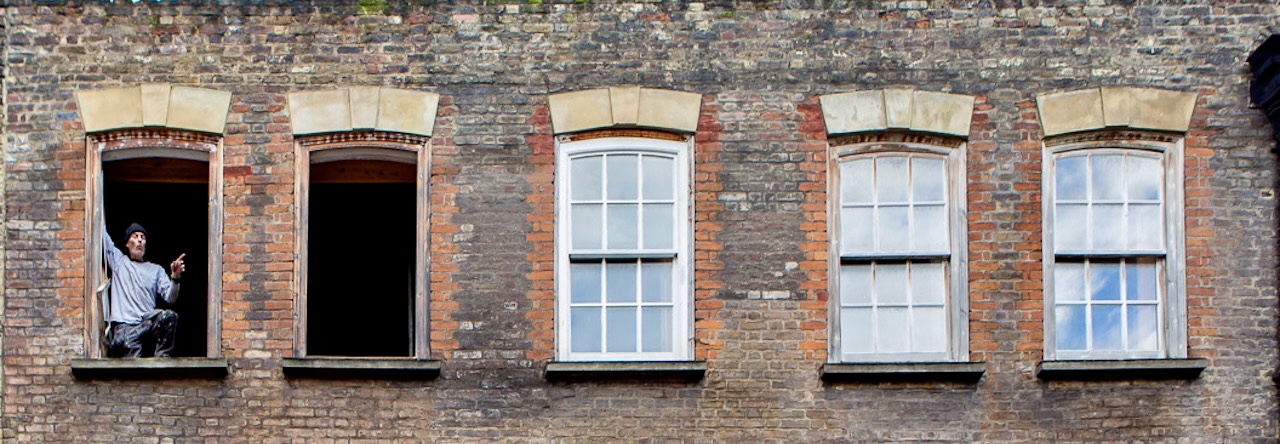
After it was finally abolished in 1851, many of those bricked-in windows were reopened (so the full impact of the tax is no longer visible of course) and it’s interesting that 2 Wilkes created these mini windows within the two on the front elevation that you can see on the post’s main photo from 1909 and this one from 1972, and also one in the rear stairwell. Perhaps it was a cheap way to get extra light (when the area was at its poorest) without the expense of recreating the entire sash window.
I wondered if it might’ve been the landlord trying to create two more rentable rooms (the two front ones are for small walk-in closet rooms) during the time when it was in multiple occupation – which peaked in 1891 with 32 people from 8 different families. However Dan Cruickshank remembers these closets as being toilets in the past.
“It always interested me because internal water flushed loos were rare in Spitalfields until recent times. Most had water flushed loos placed in out-houses (as in all the houses on the east side of Elder Street), and these were general located over the cess pit in the rear yard”
Dan Cruickshank
Although there was an outside toilet at 2 Wilkes Street, it would’ve been totally inadequate for such a crowded house share, so additional loos had to be placed inside (perhaps also increasing the rent they could charge). It seems ironic that a house so ahead of the curve with inside loos is now the last one to be saved from dereliction.
The door to the old outside loo (now leading to the neighbour’s garden!)
Not all bricked-in windows are the result of the window tax. They were also for aesthetic reasons since well before the tax was introduced. E.g. many houses on Elder Street, and here on the 2nd photo (by photographer Paul Whitbread) of the corner of Princelet and Wilkes Street, have blind windows straddling the party wall to retain the rhythm of the windows.
The corner of Wilkes Street and Princelet Street – showing party wall with 6 Wilkes Street to the right
There will be clues as to whether a blind window was original or not. E.g. this photo shows the remaining blind window in 2 Wilkes Street from the inside. Our plan is to reopen this one too.
2nd floor room with bricked in window
The other 3 were reopened 10 years ago when work (briefly) started, but never finished. Sean has been busy making new windows for all 3 of them.
Leave a comment below and subscribe for future updates…
These are some of the common things I found amongst the bags of earth and rubble in the basement from the excavation that was started and abandoned 10 years ago.
Neighbour and historian Dan Cruickshank encouraged me to sift through them to see what historic relics there might be in there.
Most of it predates the house as they dug below the original floor, though I also found lots of 20th century buttons that were probably still scattered around the basement floor after its last use in 1976 as a Ladies Clothing Manufacturer (it’s been empty ever since!)
In the 17th and 18th century, the price of tobacco dropped as imports increased, and the habit became widespread (no longer just for the wealthy). Clay pipes were the cigarettes of the day – often pre-filled with tobacco and sold for single use! So it’s no wonder that clay pipes are a common find.
The illustrated chart dates the ones I found as early 18th century – perhaps some were the pipes smoked by the builders who built the house!
The biggest surprise was how many oyster shells I found! I’d heard that oysters weren’t always the delicacy they are today. Dan explained to me:
“Oysters from the Thames were cheap food in the 18th century but became extinct in the 19th century due to the increasingly polluted nature of the river. Even for oysters there can be too much of a good thing. So, oysters had to be shipped-in to London and prices went up. Oysters are an odd story. There is a myth that the Romans introduced into English waters. Not so. One of the reasons the Romans invaded was to get their hands on the famed English oysters. The challenge the Romans had was to keep the oysters alive on the journey from England to Italy – when they arrived the precious oysters recovered from the journey and enjoyed themselves for a while in well-appointed oyster farms – being fattened up I suppose.”
Dan Cruickshank
Finally, here’s a photo of a letter from an old printing press. The census of 1851 shows there was a printer living there. Could it be his?
Leave a comment below and subscribe now for future updates…